
Cave Casualties Healing and Injury Treatment
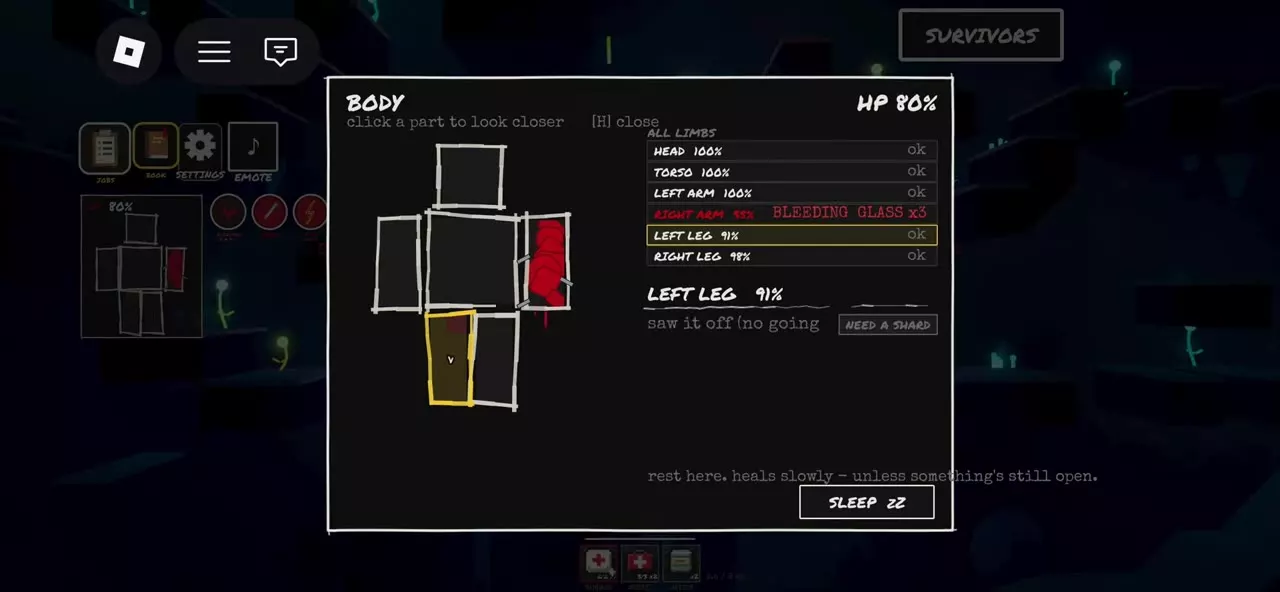
Open BODY to identify the injured part and choose its treatment. Bleeding, embedded fragments, damaged joints and infection need separate care, even when they affect the same limb.
Press H or select MENU → BODY, then choose the injured part. Remove embedded fragments slowly, wrap bleeding wounds clockwise and finish with TIE IT OFF. Replace dirty dressings, use SPLINT to align broken bones and RELOCATE to guide dislocated joints back into place. Antibiotics slow infection; Antiseptic with a clean dressing suppresses it. A rotting limb must be removed. Use Painkillers and rest for pain while continuing to treat the underlying injuries.
Inspect the Injured Body Part
Hover over the status icons beside HP to read their descriptions, then inspect the affected part directly.
- Press H, or open MENU → BODY.
- Select HEAD, TORSO, LEFT ARM, RIGHT ARM, LEFT LEG or RIGHT LEG using the diagram or list.
- Read the selected part’s health, condition labels and treatment buttons.
Overall HP and body-part health are separate readings. A high overall HP value does not mean an injured arm or leg is healthy.
| Indicator | What to read |
|---|---|
| BLEEDING | Blood loss in ml/s |
| GLASS / SHANKED | Embedded fragment count |
| BANDAGED | Dressing condition |
| INFECTED | Infection indicator |
| BROKEN BONE | Fracture treatment |
| DISLOCATED / POPPED | Joint relocation |
| ROTTING | Dead tissue |
Several conditions can occupy the same part. A bandaged limb can still contain glass, have an infection or need bone treatment. After each operation, return to BODY and check which labels remain.
CUT IT OFF is not a diagnosis: the option is also available on healthy limbs. Identify dead tissue from the ROTTING warning before choosing amputation.
Stop Bleeding and Secure a Dressing
Prepare a Bandage, a Rag, or a Medkit supplying a Clean Bandage. Prefer a clean Bandage; a Rag is an improvised fallback that gets dirty easily. Untreated blood loss can end in BLED OUT.
- Select the bleeding part in BODY. If fragments are embedded, remove them carefully and inspect the wound again.
- Choose BANDAGE, or take a Clean Bandage from a Medkit and select the affected part.
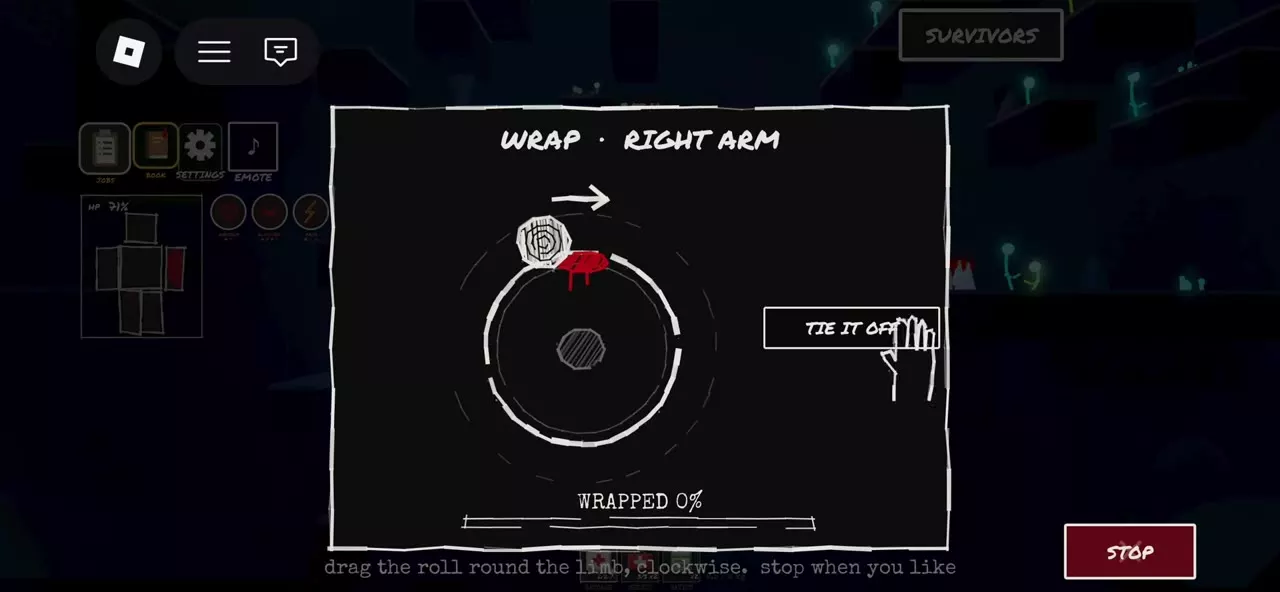
- In WRAP, drag the roll clockwise around the limb. Watch WRAPPED progress and the displayed HP recovery.
- If SLIPPED appears, continue wrapping to build progress again. If OUT OF GAUZE appears, finish securing the wrap with the material already applied.
- Select TIE IT OFF, or press Q when the wrapping interface displays that control.
Recovery takes effect gradually after the dressing is secured. A clean, fully secured wrap can grant 20 HP of gradual recovery; use the amount displayed for your current wrap rather than treating that example as a fixed reward for every dressing.
If the part already has a dressing, remove it through TAKE OFF before applying another. Taking a Clean Bandage from a Medkit consumes a supply use even if you stop wrapping at 0%, so choose the treatment before taking the supply.
Another player can treat your wounds and remove dressings. Check which part they treated and inspect your remaining injuries afterward.
The separate tourniquet option requires a Lasso. Without one, its slot displays NO LASSO.
Remove Glass and Embedded Fragments
The SHANKED description identifies the injured hand or foot and its embedded glass or rusty splinters. Select the corresponding arm or leg in BODY.
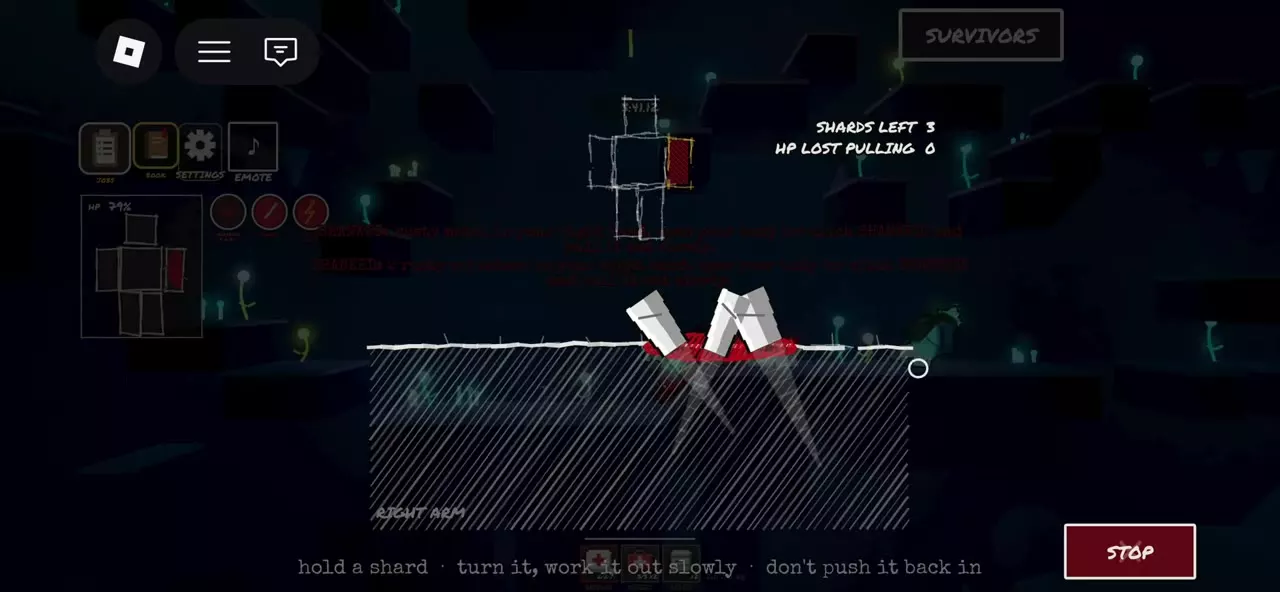
- Choose PULL OUT GLASS. With Tweezers available, use the tool and select the part, or choose TWEEZERS in its BODY panel.
- Grip a fragment, rotate it and work it outward slowly. Do not push it back into the wound.
- Repeat until SHARDS LEFT reaches 0. Watch HP LOST PULLING while extracting.
- Return to BODY and dress any wound that is still bleeding.
TOO FAST warns that your pulling is causing damage. Tweezers make extraction gentler and reduce pain and damage, but fast pulling can still cost HP. Slow handling can finish with 0 HP lost and ALL OUT CLEAN.
Watch TWEEZERS USES as you work: extracting fragments wears the tool down, and it can break during treatment. Use the remaining fragment count to judge completion. RMB or STOP ends the operation; reopening BODY after an interruption lets you check what remains.
Fragments can remain beneath a dressing. Likewise, ALL OUT CLEAN confirms the extraction result—it does not mean the wound has stopped bleeding or that infection is gone.
Change Soiled or Filthy Bandages
Read the dressing condition in BODY: CLEAN, SOILED or FILTHY. Prepare a clean replacement before removing dirty coverage from a wound that still needs dressing.
- Select the bandaged part and choose TAKE OFF.
- Wait for UNWRAPPING to finish.
- Inspect the uncovered part. If OPEN WOUND or BLEEDING remains, apply a clean dressing and complete the wrap.
- Check the new dressing and any remaining infection separately.
Removing a dressing can expose active bleeding again. If the part has healed and no longer shows an open wound, inspect its remaining conditions before using another dressing.
A removed dressing that is still clean enough can be reused. A wet, dirty Bandage becomes a Dirty Bandage for washing. Judge reuse from its actual condition rather than treating every removed dressing as dirty.
Set a Broken Bone
Have a Splint available; a Medkit also supplies Splints. Use this treatment for a part marked BROKEN BONE.
- Select the fractured part in BODY and choose SPLINT to enter SET.
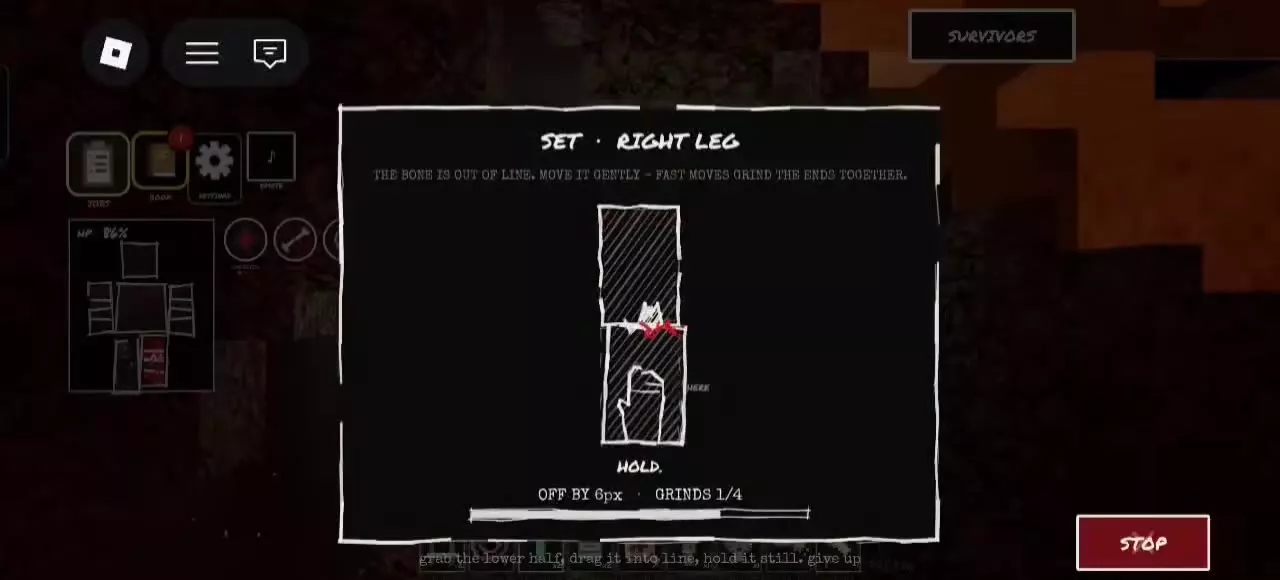
- Gently drag the lower bone segment toward the upper segment. Fast movement grinds the broken ends together.
- Align the ends and hold still. Use the offset display to guide small corrections and watch GRINDS.
- Continue until SET appears and the bone-set confirmation follows.
- Return to BODY and look for SPLINTED — healing.
The right-leg SET interface displays a GRINDS counter out of 4. Make gentle corrections instead of dragging rapidly back and forth. STOP ends the attempt.
A splinted fracture is healing, but its other injuries still need care. Dress an open wound and control infection separately. Severe pain can interrupt bone setting through unconsciousness; relieve the pain and inspect BODY before resuming treatment.
Relocate a Dislocated Joint
A part marked DISLOCATED or POPPED needs joint relocation. A clean dressing does not fix its position.
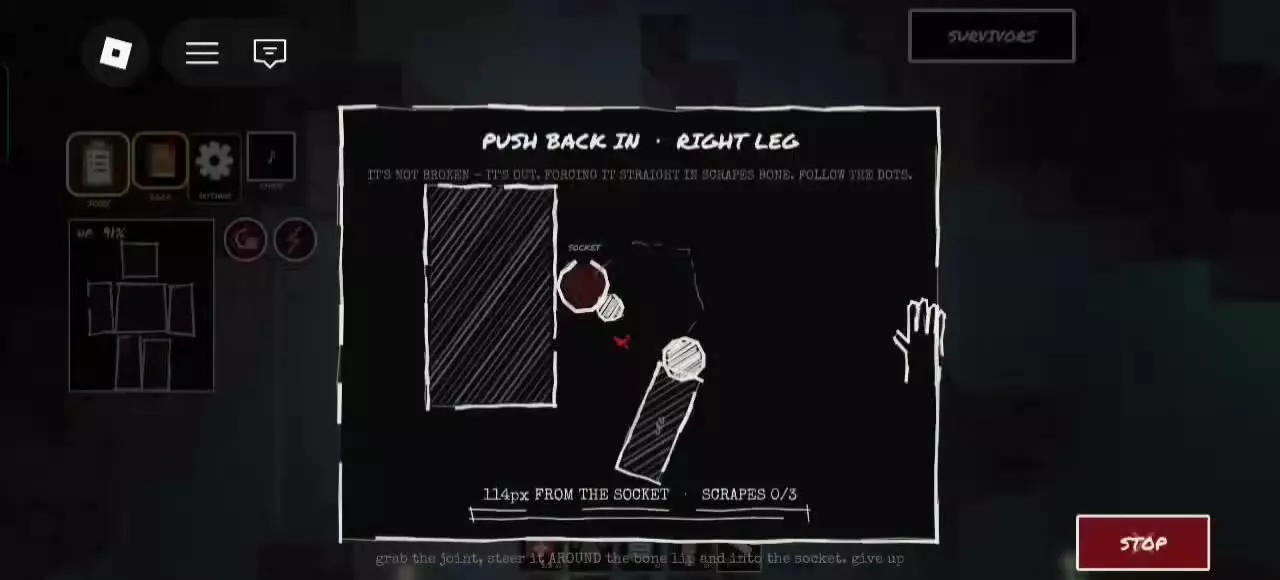
- Select the affected part in BODY and choose RELOCATE to open PUSH BACK IN.
- Grab the joint and follow the dotted route around the bone rim, toward the socket.
- Watch the distance-to-socket display and SCRAPES counter as you guide it in.
- Move the joint into the socket until CLUNK and the relocation confirmation appear.
Forcing the joint straight through the bone causes scraping. The leg relocation interface displays SCRAPES out of 3; use the dotted route to steer around the obstacle. The pixel distance helps you approach the socket rather than serving as a fixed success threshold. STOP ends the attempt.
After relocation, check BODY for any wound, infection or dirty dressing that still needs treatment.
Control Infection Before a Limb Rots
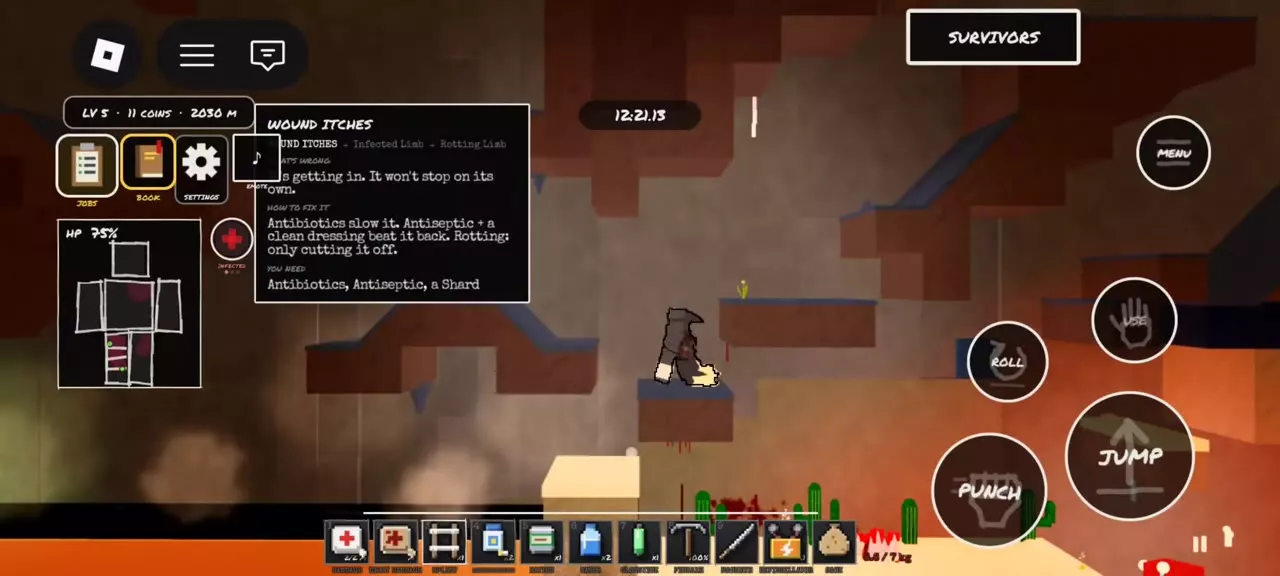
Infection progresses from Wound Itches to Infected Limb and then Rotting Limb. It does not stop on its own.
| Treatment | Effect |
|---|---|
| Antibiotics | Slows infection progression |
| Antiseptic + clean dressing | Suppresses infection |
| Warm-water soaking | Slows infection |
| Amputation | Removes rotted tissue |
Treat an infected wound
- Replace SOILED or FILTHY dressings with clean coverage.
- Apply Antiseptic with a clean dressing. Select it and press LMB, or use MENU → YOU → Pour antiseptic on your wounds. Let the application progress finish.
- Use Antibiotics to slow progression. Select them and press LMB, or choose Take antibiotics under MENU → YOU, then finish the use progress.
- In The Overgrowth, soak in the warm lakes to slow infection; tending wounds there also helps keep them cleaner.
Recheck the infected part after treatment. A clean Bandage can stop bleeding and restore HP while INFECTED remains. High body-part health also does not rule out infection or rot. Infection continues spreading during sleep.
When the limb is rotting
ROTTING — IT HAS TO COME OFF means the tissue is dead. Medicines and wrapping cannot restore it. A rotting part can still offer BANDAGE for an open wound, but dressing that wound does not reverse the rot.
Rot spreads toward the brain and sustains brain-related symptoms. Prepare a Shard and follow the amputation and stump-care steps to remove the dead limb and treat the resulting wound.
Pain, Concussion and Brain Damage
Relieve pain before it interrupts treatment
Pain includes Pain, Severe Pain and Unbearable states. Further hits in a short period worsen it and can make you pass out—even with high overall HP. Unconsciousness can interrupt fragment extraction or bone setting.
Select Painkillers and press LMB to take one, or rest to relieve pain. Continue treating the wounds, fragments, fractures and infections causing the problem. Pain relief does not replace those treatments.
Read the sleep preview before sleeping: pain can repeatedly wake you. If you lose consciousness, use the passing-out and recovery controls to regain control, then return to BODY to check your injuries.
Match recovery to the brain condition
- Concussion: a buzzing head, tilted vision and dizziness accompany control problems. Left and right can swap, item selection can go wrong and landings can fail.
- Brain Damage: speech becomes garbled, hands and feet fail to obey reliably, and ropes slip.
- Psychosis: endure the episode until it passes; ordinary recovery methods do not help during the attack.
For Concussion or Brain Damage, rest, sleep and Painkillers speed recovery. If a rotting limb remains, rot in the blood keeps the brain problem active. Address that continuing cause rather than relying on rest or pain relief alone.
Medical Supplies, Sleep and Amputation
- Medical supplies and prosthetics: compare dressings, medicines, Splints and extraction tools, with their purchase and item-detail entries.
- Crafting recipes and cleaning: wash removed Dirty Bandages and choose cleaning recipes for the water and materials you have.
- Sleep, rest and stamina: read the recovery preview before sleeping. Open or rotting wounds can prevent HP recovery, and sleeping does not stop infection.
- Amputation and stump care: prepare the tools, remove a rotting limb, dress the stump and continue moving afterward.